10 Digital Marketing Trends for 2027
Every Business Should Know
By EP. Team
Introduction: The Year Discovery Changes Hands
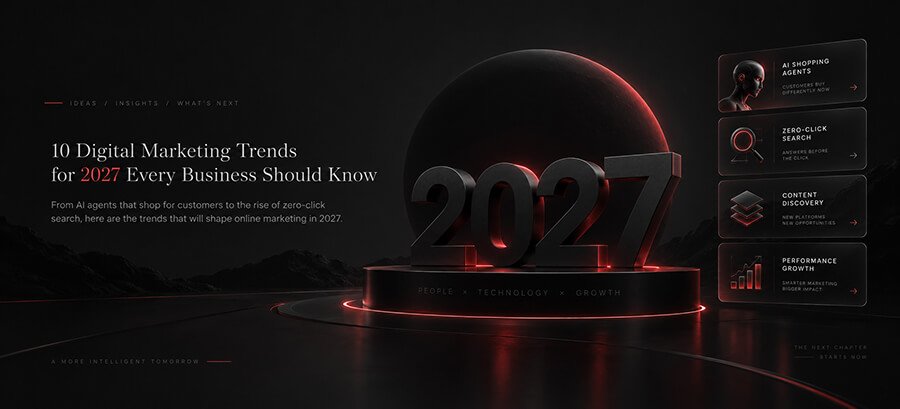
For two decades, online marketing followed a simple path: a customer typed a query, scanned ten blue links, clicked a website, and maybe bought something. In 2027, that path is breaking apart. AI assistants now answer questions directly, summarize products, and in some cases complete the purchase themselves.
Recent research shows how AI is reshaping search behavior. A research preprint by Wang and colleagues, based on a preregistered field experiment with 1,100 participants, found that removing AI Overviews and AI Mode increased click-through rates to publishers. An AI Mode-only experience reduced click-through rates and weakened participants’ reported experience and trust. The findings highlight the need to measure how AI answers affect website discovery.
This does not mean digital marketing is shrinking. It means the rules of visibility are being rewritten. The businesses that win in 2027 will be the ones that make themselves easy for both people and machines to find, trust, and choose. Below are the 10 trends every business should plan around, with a practical action for each.
The 10 Digital Marketing Trends for 2027
1. Answer Engine Optimization (AEO) Becomes Standard Practice
Ranking first on Google is no longer the only goal. Brands now also need to be the source that ChatGPT, Gemini, Perplexity, Claude and Google AI Overviews quote when they answer a question. This discipline goes by several names, including AEO and GEO (generative engine optimization), but the core idea is the same: create clear, well-structured, trustworthy content that an AI system can confidently cite.
Action: Rewrite key service and product pages so each one answers a specific customer question in the first two or three sentences, then supports that answer with detail, data, and examples.
Video Tutorial credit: ProfileTree Digital – YouTube channel
2. Zero-Click Search Forces New Success Metrics
As AI summaries answer more questions on the results page, website visits alone cannot capture a brand’s visibility. NielsenIQ and Similarweb’s planned agentic commerce measurement solution reflects this shift: its proposed framework connects AI recommendations and product visibility with downstream traffic, conversions, and verified sales. In 2027, businesses should evaluate whether AI-driven discovery contributes to commercial outcomes alongside organic sessions.
Action: Track brand mentions in AI answers, branded search volume, and assisted conversions alongside organic sessions.
3. Agentic Commerce: AI Agents Shop on the Customer’s Behalf
AI agents are becoming part of the shopping journey, from product discovery to purchase. Salesforce’s Fourth Edition State of Commerce research, drawing on surveys of 3,450 commerce professionals, reports that the use of agentic search as the first step in shopping grew 200% year over year. This measures where journeys begin, rather than completed autonomous purchases, but it signals a clear shift in how customers discover products. For 2027, keeping catalogs, prices, and policies readable by AI agents is a practical priority.
Action: Keep product data complete and consistent: prices, stock, shipping times, return policies, and specifications.
4. Structured Data Becomes a Competitive Advantage
AI systems prefer information they can parse without guessing. Schema markup for products, services, FAQs, reviews, events, and local business details helps machines understand exactly what a page offers.
Action: Audit your website’s schema markup and fix gaps on your highest-value pages first.
5. First-Party Data Powers Personalization
Third-party tracking keeps getting less reliable because of privacy laws, browser restrictions, and consumer expectations. The most valuable data in 2027 is the data customers give you directly: email sign-ups, preferences, purchase history, and quiz or survey answers.
Action: Offer a genuine reason to share data, such as a useful guide, a member discount, or a personalized recommendation tool, and always ask with clear consent.
6. Video Becomes a Search Channel, Not Just a Social Channel
YouTube functions as one of the largest search engines in the world, and AI assistants frequently cite video in their answers. Short vertical clips build reach, while longer tutorials build trust and get referenced by AI tools.
Action: Turn your most common customer questions into short, well-titled tutorials with full captions and detailed descriptions.
Video Tutorial credit: Exploding Topics – YouTube channel
7. Human Expertise Is the New Differentiator
AI makes generic content cheap and endless. As a result, audiences and algorithms reward content that shows real experience: original data, case studies, expert opinions, and honest lessons from actual projects.
Action: Add author bios, client results, and first-hand insights to every major article you publish.
8. Creator and Community Marketing Keep Growing
Creator marketing continues to grow, with trust and expertise central to its appeal. The IAB’s CreatorFronts recap highlights the importance of credible voices, authentic audience relationships, and stronger measurement as the sector expands. For businesses planning for 2027, partnerships with relevant niche creators and useful community content offer a way to connect with customers through people they already follow and trust.
Action: Partner with two or three micro-creators in your niche rather than one expensive celebrity account.
9. AI-Assisted Marketing Operations
In 2027, AI is less a shiny tool and more the engine room of marketing teams. It drafts briefs, segments audiences, tests ad variations, summarizes reports, and automates email flows. Teams that combine AI speed with human editing and strategy will move faster than competitors without lowering quality.
Action: Document one repeatable workflow, such as a monthly newsletter or ad testing, and use AI to speed up each step while a person approves the final output.
10. Measurement Shifts to Revenue and Business Impact
With changing search behavior and less tracking data, likes and impressions tell an incomplete story. Google’s guidance on proving AI Search ROI emphasizes connecting discovery with business outcomes and improving transparency across the advertising journey. Leaders should evaluate marketing’s effect on leads, sales, and customer lifetime value, using methods such as marketing mix modeling, incrementality tests, and CRM-based attribution.
Action: Connect your website forms, CRM, and ad platforms so every lead can be traced to its source and its eventual revenue.
How to Prepare Your Business for 2027
You do not need to chase all ten trends at once. Start with the foundations that support most of them:
- Audit your AI visibility. Ask ChatGPT, Gemini, and Perplexity the questions your customers ask, and note whether your brand appears.
- Fix your website’s technical base. Fast loading, mobile-friendly design, clean structure, and complete schema markup help both people and AI systems.
- Publish answer-first content. Build pages and videos around real customer questions, with clear answers at the top.
- Grow your first-party audience. Invest in email lists, communities, and loyalty programs you own.
- Measure what matters. Link marketing activity to leads and revenue, not just traffic.
Conclusion
The biggest digital marketing trend for 2027 is not a single tool or platform. It is the move from being searchable to being recommendable. AI assistants, shopping agents, and algorithm-driven feeds now stand between many brands and their customers. Businesses that provide clear answers, structured data, real expertise, and a trustworthy brand will be the ones these systems choose to recommend.
The good news is that the work starts with fundamentals every business can control: a strong website, genuinely helpful content, and a direct relationship with customers. Start building those now, and 2027 becomes an opportunity rather than a threat.
References and Links
- Salesforce — Shopping’s New First Step: Agentic Search Grows 200% as Purchase Journeys Start in AI Chats (September 2026)
- IAB — 2026 IAB CreatorFronts Event Recap (September 2026)
- Think with Google — Search’s expansionary moment is here: How brands can turn AI into proven ROI (September 2026)
- NielsenIQ — NIQ and Similarweb Advance Agentic Commerce Measurement for the AI Shopping Era (September 2026)
- Wang and colleagues (arXiv preprint) — AI in Search Reduces Publisher Referrals Without Improving User Experience: Experimental Evidence (August 2026)