Why Women in STEM Matter to All of Us
By Elias Prevenas • 11 October 2026 • 7-minute read
Quick answer: Women in STEM matter to everyone because the technology, medicine and AI that shape our daily lives work better, and more safely, when the people who build them reflect the people who use them. In 2026 women are still a clear minority in AI and engineering. Closing that gap means fairer products, a larger talent pool and a stronger economy for all of us.
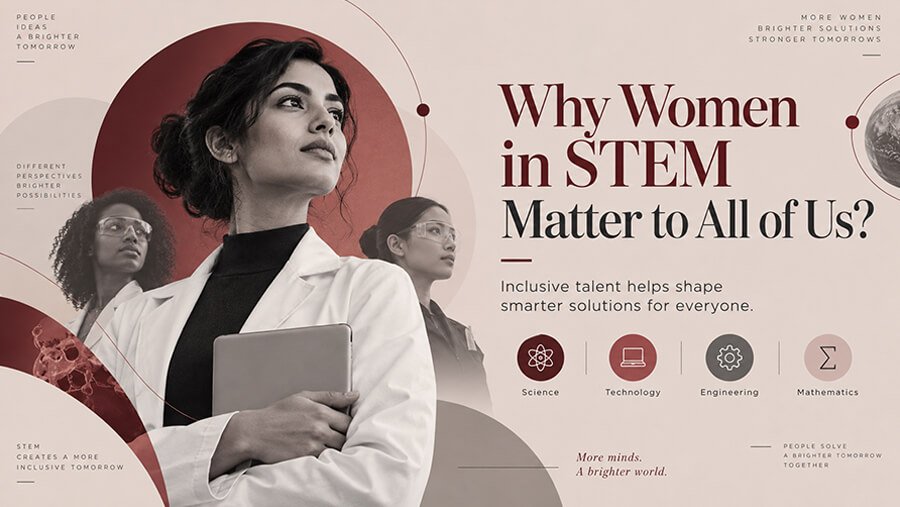
Think about the last time a piece of technology simply did not work for you. A voice assistant that struggled with your accent. A fitness app that made assumptions about your body. A form that had no option that fit your situation. Small frustrations like these usually share one root cause: somebody, somewhere, was missing from the room when the product was designed.
That is the real reason the debate about women in science, technology, engineering and mathematics (STEM) is not a niche topic or a "women's issue." It is a question about who gets to shape the world the rest of us live in. And right now, at the exact moment artificial intelligence is rewriting how we work, that question has never been more urgent.
The 2026 Picture: Progress, but Slowing Down
The newest data from the past few months tells a mixed story. The World Economic Forum's Global Gender Gap Report 2026, published on 16 September, marks twenty years of tracking gender parity across 145 economies. The good news is that the world has now closed around 69% of the overall gender gap. The bad news is that progress over the last decade has been noticeably slower than in the decade before it.
Technology is where the gap is sharpest. According to the WEF report, fewer than one in five AI engineers are women. LinkedIn research released in August 2026 adds more detail:
- Women made up only 26% of AI hires in 2025, compared with roughly half of hires into non-AI jobs.
- A typical AI job posting now lists around $177,000 in pay, compared with about $80,000 for non-AI roles, so the gap is also a pay gap.
- Across 27 countries, women hold just 13% of C-suite AI leadership roles at AI companies.
Separate Randstad data reported by Bloomberg in August shows that only about 29% of AI-skilled workers worldwide are women, and that women are less likely than men to be offered AI tools at work in the first place (35% versus 41%). In other words, part of the problem is not talent or interest. It is simple access.
Why This Is Everyone's Issue
1. Better products for every customer
Teams design from their own experience. For decades, crash-test dummies were modelled on an average male body, and many early health and fitness apps overlooked basic needs of half their users. When teams include women engineers, researchers and designers, those blind spots are caught earlier, often before a product ever reaches the market. Everyone benefits from that, including men, children and older users whose needs also tend to fall outside the "default."
2. Fairer and safer artificial intelligence
AI systems learn from data, and they inherit the gaps and biases in that data. If the people who choose the data, test the models and set the rules come mostly from one group, the results will quietly favour that group. Hiring tools, credit scoring and medical diagnosis are areas where those hidden biases have real consequences. More women building and governing AI is one of the most practical safeguards we have.
3. A stronger economy and a bigger talent pool
Almost every industry is short of skilled engineers, data specialists and developers. Ignoring half of the population is not only unfair; it is bad business. At the launch of the 2026 report, WEF managing director Saadia Zahidi warned that the jobs most disrupted by AI tend to be the ones where women are concentrated. If women are not also moving into the new, better-paid AI roles, the benefits of this technology wave could flow mainly to men, widening inequality instead of reducing it.
4. More innovation from more perspectives
Diverse teams ask different questions. They notice different problems, test different ideas and challenge assumptions that a uniform group would never question. Innovation does not come from more of the same thinking. It comes from combining viewpoints, and gender is one of the most basic forms of diversity a team can have.
5. Role models create the next generation
Girls are far more likely to picture themselves as engineers or scientists when they can actually see women doing that work. Every woman who stays and rises in STEM makes the path visible for the next person. When women leave, that signal is lost.
Video credit: TEDx Talks – YouTube channel
The Good News: Change Is Already Happening
Despite the headlines, there are strong signs of momentum. In South Africa, the recruitment platform Pnet reported in August 2026 that women now make up more than half of professionals listing generative-AI content tools on their CVs, and roughly 39% of those listing general AI skills. Women are clearly ready to learn. They need equal opportunity to use those skills.
In Europe, the European Centre for Women and Technology (ECWT) describes itself as the largest network for women in the digital world on the continent. Its work focuses on four practical goals: getting more girls to study ICT and STEM, attracting and retaining women in ICT careers, designing gender-sensitive technology, and supporting women's digital entrepreneurship.
ECWT has also launched the Role Models in STEM portal, an EU-supported platform that collects real career stories and advice from women across 16 sectors, from microelectronics and space technology to AI research. It currently features more than 170 profiles and over 2,500 answers to a detailed questionnaire. Resources like this matter because they turn abstract statistics into human stories that a 14-year-old can relate to.
Video credit: IFLScience – YouTube channel: Elke Wolf explains why attracting more women to STEM requires changes to academic culture and STEM education, rather than expecting women to adapt to existing systems.
How You Can Help: Practical Steps
Supporting women in STEM does not require a big budget. It requires consistent, everyday choices.
If you are a parent or teacher:
- Encourage curiosity in coding, maths and building projects from an early age, without labelling subjects as "for boys" or "for girls."
- Share stories of real women scientists and engineers, such as the profiles on role-models.eu.
If you run a business or lead a team:
- Give everyone equal access to AI tools and training, and track who actually uses them.
- Publish clear pay bands and promotion criteria.
- Offer mentoring and, just as important, sponsorship from senior leaders.
- Make flexible work normal for everyone, not a special exception.
If you work in tech or web development:
- Practise inclusive design: test products with diverse users before launch.
- Invite women developers, designers and speakers onto your projects, panels and podcasts.
- Credit and showcase the work of women on your team publicly.
Everyone can: share and amplify women's achievements online, challenge stereotypes when you hear them, and support organisations that open doors.
Frequently Asked Questions
Why do women in STEM matter to everyone?
Because the products, medicines and AI systems we all rely on work better and more safely when the teams building them reflect the people using them. A more balanced workforce also widens the talent pool and strengthens the economy.
What share of AI engineers are women in 2026?
According to the World Economic Forum's Global Gender Gap Report 2026, fewer than one in five AI engineers are women. LinkedIn data shows women made up 26% of AI hires in 2025.
How can companies support women in STEM?
Provide equal access to AI tools and training, publish transparent pay bands, run structured mentoring and sponsorship, offer flexible work, and make women's work visible inside and outside the company.
What is the difference between STEM and STEAM?
STEM stands for science, technology, engineering and mathematics. STEAM adds the arts, highlighting creativity and design as a core part of innovation.
Conclusion
Supporting women in STEM is not about doing anyone a favour. It is about building technology that works for everyone, AI that treats people fairly, and an economy that uses all of its talent. The data from 2026 shows that the gap is closing too slowly, especially in AI, the field that will shape the next decade. The good news is that every parent, teacher, employer and developer can help speed it up. When women succeed in STEM, all of us gain.
References and Further Reading
- World Economic Forum, Global Gender Gap Report 2026 (16 September 2026): weforum.org/publications/global-gender-gap-report-2026
The 20th edition of the WEF's annual benchmark of gender parity across 145 economies, including new data on women's place in the AI economy and the finding that fewer than one in five AI engineers are women. - AFP via Citizen Digital, "AI risks wider gender inequality in jobs market: World Economic Forum" (17 September 2026): citizen.digital
News coverage of the report launch in London, where WEF and LinkedIn leaders warned that AI is disrupting the roles where women are concentrated and could widen inequality. - Allwork.Space, "Women Made Up Just 26% Of AI Hires In 2025, LinkedIn Finds" (19 August 2026): allwork.space
Summary of LinkedIn data showing women were only 26% of AI hires in 2025, the large pay premium attached to AI roles, and women's 13% share of AI C-suite positions. - AfroTech, "13% Of AI Executives Are Women: Here's Why That's A Problem" (August 2026, on LinkedIn's July 2026 "Triple Penalty" study): afrotech.com
Breakdown of LinkedIn's "Triple Penalty" research on why women are underrepresented in leadership, in AI jobs and at AI companies, and why that matters for how AI is built. - Bloomberg, "AI's lucrative jobs boom is leaving women behind globally" (18 August 2026): bloomberg.com
Reports Randstad findings that only about 29% of AI-skilled workers are women, and that women are less often given access to AI tools at work than men. - Bizcommunity, "Pnet Job Market Trends Report for August 2026: How SA women are embracing AI in the workplace" (August 2026): bizcommunity.com
Women's Month analysis of 1.5 million South African CVs, showing women quickly closing the AI skills gap, especially in generative-AI content tools. - European Centre for Women and Technology (ECWT): ecwt.eu
Europe's largest network for women in the digital world, offering research, toolkits and projects that bring more girls into STEM and keep women in ICT careers. - Role Models in STEM portal (ECWT, Code4Europe project): role-models.eu
An EU-supported portal from ECWT with real career stories and advice from 70+ women working across 16 STEM sectors, from AI to space technology.